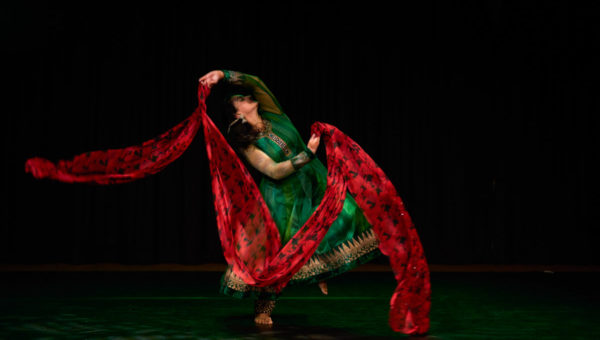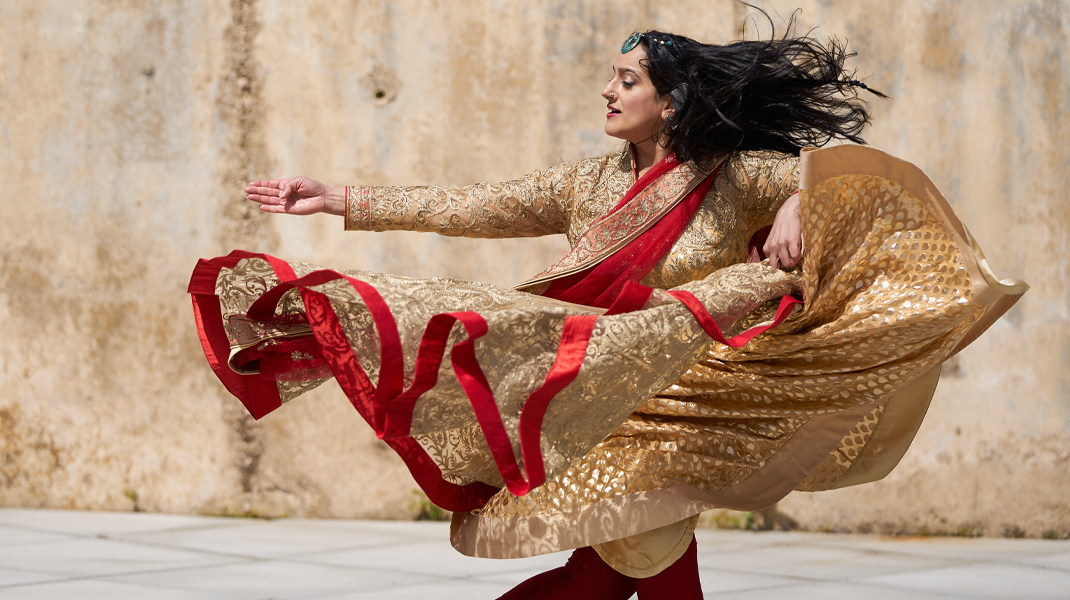
To mark the coming of Sonia Sabri Company’s show, Roshni, coming to York Theatre Royal we caught up with Sonia Sabri MBE to find out more about the creation of the show.
Tell us about the creative process and inspiration behind Roshni
Our research started in Autumn 2020 when I began hold online discussions about art, life, purpose etc. This developed into a survey, completed by people of all of walks of life, to share their experiences of the pandemic. We received about 100 responses! There was an outpour of personal stories, questions about the purpose of life, why the world exists, to sharing mental and physical health concerns, to spirituality and other things.
In Autumn 2021 – a year later – I started to think about how to manifest a production from what had been shared with me. It was a challenge because it was not about merely re-enacting stories but was about collating them into a thematic concept. I am drawn to symbology and metaphorical aesthetics, and it took a long while to distil it into a three-part performance.
Music is intrinsic to my research and creative process, so I brought Sarvar (our Music Director and Co-Founder) into experimenting with musical ideas. It became clear quite quickly that this work needed musicians from a range of musical backgrounds and with excellent improvisational skills. We head hunted some local musicians who played Celtic, North African, Iranian, and Eastern European music.
From Jan 2022, we did several weeks of research and development in the studio exploring ideas and finding methods to work with artists of different disciplines.
Roshni, from concept to aesthetic, treasures the lived experiences shared with us and presents them to the wider world to evoke, to observe and to be affected, igniting a light of positivity and healing.
Did you have any choreographic influences?
As an artist I am always striving for better within my craft, form and technique. I spend a lot of time watching and reading about creatives from various disciplines including visual artists, composers, choreographers and what they create, how they create, and what inspires them, and that is what influences my own creativity.
The experiences and values that people shared with us helped direct my choices for the choreography. I have had several months of experimenting with ideas, and I continue to do so as the show matures. There are several phases within the show that are improvisational which allows me to try new ideas that are often born from the moment of performance itself.
Who are the characters in the piece portraying?
The second piece in Roshni is based on a narrative structure. So, in that there are scopes of characters rather than protagonists and antagonists. they represent groups of people: those who were surveyed and others who we are aware of but are distant from because of the way the matrix of society is set up. These include the elderly, the young, the greedy, the users, the deceivers, the authoritarians, the carers, the broken and the survivors. This piece had to be created in this way to delve into the craft of symbology and at the same resonate powerfully with the audience.
Can you tell us more about how the musical elements of the piece and how they came together with the choreography?
I think of the music and dance in Roshni as being deeply in conversation with each other! Sarvar and I were passionate about celebrating the different cultural styles of music and skills the musicians specialised in. The concept, music and choreography were developed together; through lots of testing of ideas and what felt in keeping with the needs of the show.
Roshni has no written music. Everything is learnt and played by ear. There is a combination of some set music and improvisational. Similarly, the choreography has a structure but there is a space to improvise. So, each show of Roshni is different! There is a lot of call and response as well, so dance being led by the music or music being led by the dance and what is unfolding in the performance.
There is lots of percussive elements through tabla, footwork and mind-boggling Indian recitation, which is essentially beatboxing! The Tabla, Oud, Kaval, Clarinet, Whistle and Guitar bring rich and dynamic qualities to the sound palette, so what we have in Roshni is a unique sound that does not exist elsewhere.
What was your aim for audiences to feel and experience when watching Roshni?
My aim was for the audience to feel a whole plethora of emotions! From intrigue to joy, from frustration or hurt to bliss, to contemplate on the state of the current world, to reflect on one’s own life story.
We all have ups and downs, and some of us are in darker places than others, and Roshni offers you the strength and positive energy to make wrong things right, to make the hurt heal, and to ignite a curiosity to find a way to repair the world.
Roshni will be at York Theatre Royal from 26 Sep – 27 Sep.
Find out more information and book your tickets here.
You might also be interested in