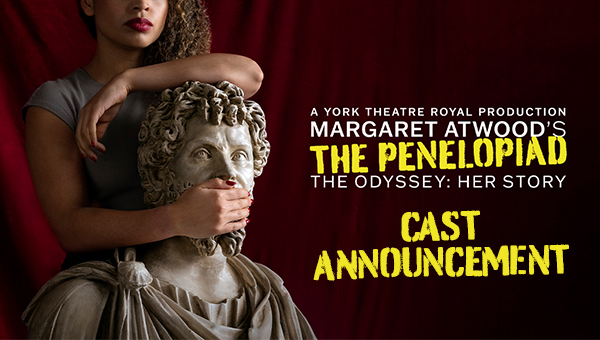
Ahead of a new revival of The Penelopiad opening this month (10 – 31 Oct), we caught up with Director Juliet Forster to find out more about bringing this play to the York Theatre Royal stage and how it brings a fresh take on an age-old story.
Tell us more about The Penelopiad and what audiences can expect?
Homer’s The Odyssey is a fantastic piece of storytelling but sadly there is very little in there about the women’s lives. What Margaret Atwood does so brilliantly with The Penelopiad is really upend that and give us the female perspective on a story that is so well-known. In true Atwood style she presents that story in a way that is both deeply arresting and witty. We go on a journey with her through to the bitter climax of the women’s story but it’s also done in such an engaging and enjoyable way.
Audiences can expect a very physical and visual form of storytelling – we will be drawing on everything from acrobatics and dance, to aerial, masks and puppetry…
Why did you decide to bring The Penelopiad to the YTR stage?
I read the novella shortly after it was published and I absolutely loved it. I personally have a real interest in the Greek classics and whilst I knew a lot about The Illiad and The Odyssey and the history of the Trojan War, I found it genuinely so delightful and invigorating to read Atwood’s feminist take on the story.
Quite some years later, in 2019, when myself and YTR’s former Chief Executive were exploring potential options for our Summer 2020 programme, we looked at The Penelopiad script and once again I was drawn in by the vibrancy of Atwood’s writing. We were all set to stage it in 2020 when of course, the pandemic hit and our plans were sadly cancelled.
Cut to 2025 when we were again looking for the right production for our 2026 season, I felt strongly that this would be a perfect opportunity to bring this project back to life. Ultimately the power of the female voice in Margaret Atwood’s version had always stuck with me and sadly in 2026, women in a time of war, violence against women, double standards and inequality are all the more relevant. We then also found out about the Christopher Nolan movie adaptation which was set to hit the big screen and it felt like an interesting time to stage a production which tells the women’s story from a completely fresh perspective.
Can you tell us about the casting process for the show?
The play focuses on Penelope as she tells her version of the story and so casting that role was obviously really crucial. Alongside this, we have the story of the maids, who helped her deceive the suitors and who interject with their own version of events. The maids really act as a sort of old Greek chorus but in a way that feels fresh and modern. They take on all the other parts and have a significant role in the play so their casting was also equally important.
For Penelope, I am thrilled to be working with the incredibly talented Amelia Bullmore. I’d recently watched Riot Women – another fantastic feminist narrative – and Amelia’s performance in that is excellent. She is a very multi-faceted actor that can really immerse herself in a character and I thought she would be perfect for the role. Amelia is super sharp and funny, and her intelligence and dry sense of humour are so well-matched with Atwood’s style of writing. For me, what is so important about the character of Penelope is the very closed off and hidden side to her nature and I think Amelia has a real inscrutable quality to her performance which feels so right for this role.
Once Amelia was cast, we then turned our attention to the maids. It was important to me to have a real range of different women cast in these roles. Often the maids are almost lumped together as one – in the original only one of them is named! – and the play really unpicks that narrative, so it was important to get that right in our casting.
The cast we have are super talented – they are all so different and bring such a diverse range of strengths and individuality. What was the most important for me was to find actors who could bring a sense of humour and playfulness to these roles which are also very physically demanding – with elements of dance, movement, aerial, singing and more.
How did you prepare ahead of rehearsals starting?
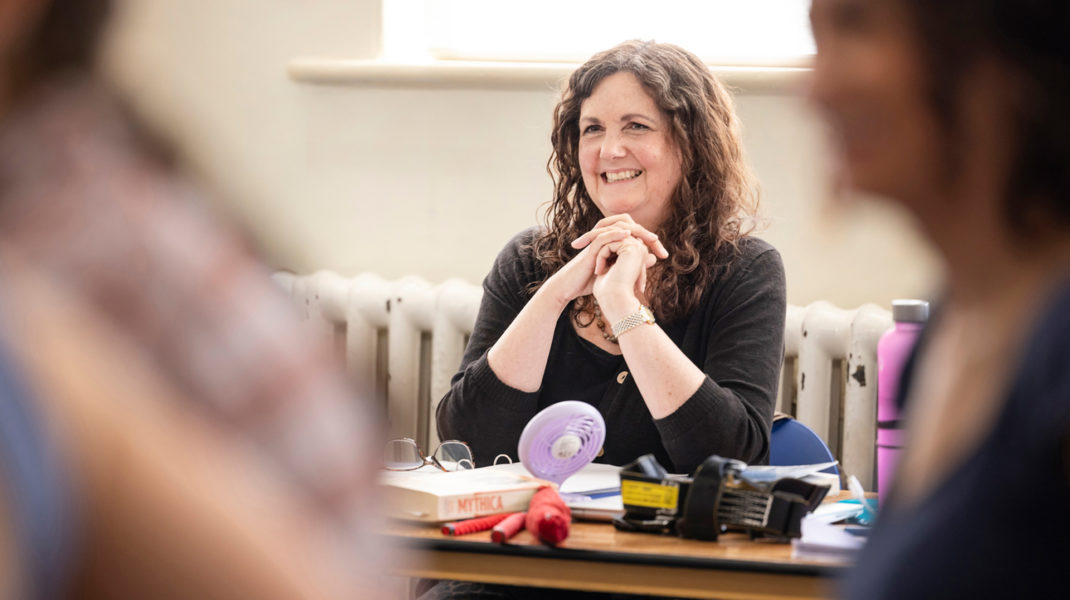
Lots of reading! Of course the original novella and The Odyssey but also I read a wonderful book called Mythica by Emily Hauser. Emily is a renowned and published classicist who is doing some consultancy with us to help us look at what life for Bronze Age women would have been like, drawing from mythology, history and archaeology – which will be useful for the actors as we delve into their characters.
Atwood of course adapted the script herself but had given me permission to add in some of the original text from the book. So I also spent some time working on fleshing that out and adding some more elements to the script.
We have a fabulous all-female creative team on board and I really enjoyed meeting with them and shaping how the production is coming together.
What would you like the audiences to think about when they go away from the show?
I hope that they come away feeling they have experienced a real visual feast. It’s going to be witty and funny, powerful and moving – and I think it will give them an insight to the story of The Odyssey from a completely different angle. But it also raises really pertinent questions not just about the past, but also the present.
I personally think it’s a great complement to seeing Christopher Nolan’s movie and will give people the chance to dig more into that story and find out more about the characters of Penelope and her maids. I hope people will also come away thinking about the power of storytelling – how we balance competing versions of the same events and which narratives end up being the ones that are remembered…
The Penelopiad is at York Theatre Royal from the 10 Oct – 31 Oct.
Find out more information and book your tickets here.
You might also be interested in...